
Awning windows are one of the most practical window styles for Sydney homes. They are hinged at the top and open outwards from the bottom, so you can let fresh air in without letting the weather in with it. If you are comparing aluminium awning windows in Sydney, this guide explains how they work, which rooms they suit, how to choose between a chain winder and friction stays, and what to decide about screens, glass and child safety before you book a measure.
How an awning window works
An awning window has a single sash hinged along its top edge. When you open it, the bottom of the sash swings outwards and the glass sits at an angle over the gap, a bit like a small awning. Light rain runs down the outside of the glass and drips away from the opening instead of blowing straight in, which is why you can often leave an awning window open during a drizzle or on a humid summer night.
Because the sash opens outwards, nothing swings into the room. An open awning window will not clash with blinds, curtains, a kitchen tap or a bathroom vanity, and it does not need any floor or bench space around it.
Where awning windows work best
Awning windows suit most rooms, but they really earn their place in a few spots:
- Bathrooms and ensuites. Set high on the wall, an awning window lets steam out while frosted glass keeps the room private.
- Kitchens. Above a sink or bench, a window that opens outwards is easier to reach and operate than one you have to slide or swing inwards.
- Bedrooms. They give steady airflow overnight, and restricted opening devices can limit how far the sash opens.
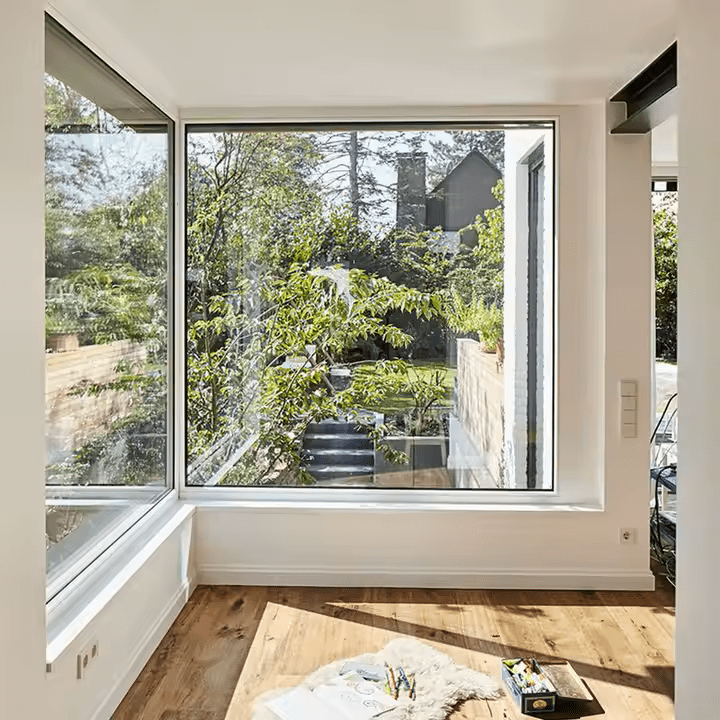
- Window walls. Awning sashes are often combined with fixed panes above or beside them, so a big opening gets plenty of light and still has sections that open.
They are less suited to walls that face a narrow side path, a deck or a pergola where people walk past, because an open sash sticks out from the wall. In those spots, sliding windows often make more sense because the sash stays within the frame.
Chain winder or friction stays?
There are two common ways to open and hold an awning window, and the right one depends on where the window is and whether it will have a screen.
A chain winder uses a small handle on the inside of the frame. You turn it to push the sash out and wind it back to close it, and the chain holds the sash firmly at any point in between. Because you never touch the sash itself, you can open and close the window without removing the fly screen.
Friction stays are hinged arms on each side of the sash that hold it in position by friction. You open the window by pushing the sash out by hand. They are simple and tidy, and they suit windows that are easy to reach and opened by hand.
Stand where you would normally open each window and imagine doing it with a screen in place. If you would have to stretch over a bench or a bath to reach the sash, choose a chain winder for that window.
Fly screens and security screens
Since an awning window opens outwards, its screen fits on the inside of the frame. We can add a matching fly screen or a security screen in stainless steel or fibreglass mesh, powder coated to match the window frame in the Dulux powder-coat range.
Frames, glass and colour
Our aluminium awning windows are made with frame widths of 48mm, 75mm or 100mm, with hollow mullion and stile sections for strength and Q-Lon seals for weather and noise. Each window is made to measure for your opening.
Glass can be single glazed up to 6.38mm or double glazed up to 22mm. The glass options are laminated, toughened, frosted and Low-E. As a general guide:
- Frosted glass suits bathrooms, toilets and windows that face a neighbour.
- Double glazing helps with outside noise and keeps rooms more comfortable, which is worth considering for bedrooms near a busy road.
- Low-E glass reduces the heat that comes through the glass, which helps west-facing rooms that cop the afternoon sun.
- Laminated or toughened glass is a sensible choice for larger panes and windows in high-traffic areas.
If you are planning a larger window wall, you can combine awning sashes with fixed glass. Our guide to aluminium fixed windows in Sydney covers where fixed panes work best and how to pair them with opening sashes.
Awning windows and child safety in NSW
Any window that opens outwards on an upper floor is a fall risk for young children. NSW Planning explains that window safety devices are currently required in apartments in strata schemes and in the bedrooms of homes built since 1 May 2013, where a window can be opened, is less than 1.7m above the floor, and the floor is 2m or more above the ground outside. These devices must limit the opening to less than 125mm. NSW Planning has also proposed extending the requirement to most other homes, so check the NSW Planning window safety page for the current position.
Our awning windows can be made with restricted opening devices and standard or barrel key locking. Talk to us about the right setup for children’s rooms and upstairs windows when we measure.
Before you book a measure
A little planning makes the measure faster and helps you get the right window for each room:
- List the windows you want to replace and the rooms they are in.
- Note what is outside each window, such as a path, deck, garden or driveway.
- Decide which windows need a chain winder and which can have friction stays.
- Think about which windows need a fly screen or a security screen.
- Choose the glass for each room, especially bathrooms and west-facing rooms.
- Have your BASIX certificate ready if your project has one.
Not sure whether awning is the right style for every room? Our guide on choosing the right window style for each room compares sliding, awning, bifold and fixed windows room by room.
Every awning window we make is made to measure in our Glendenning factory, and we supply and install it ourselves. We have been making windows, doors and screens since 2007, and you can visit the factory at 1/173 Power St, Glendenning, Monday to Friday 8am to 5pm and Saturday 8am to 2pm to see frames, glass and powder-coat colours in person.
Awning windows FAQ
Can awning windows be left open in the rain?
In light rain, usually yes. The sash is hinged at the top, so water runs off the outside of the glass rather than into the room. Close them in heavy, wind-driven rain or storms.
Can awning windows have fly screens?
Yes. The fly screen fits on the inside of the frame, and a chain winder lets you open and close the window without removing the screen.
Can I combine awning and fixed windows?
Yes. Awning sashes are often combined with fixed panes above or beside them to make a larger window with sections that open.
Can awning windows be double glazed?
Yes. Our awning windows can be double glazed up to 22mm, or single glazed up to 6.38mm, with laminated, toughened, frosted or Low-E glass.
Get awning windows made for your Sydney home
Request a measure and quote or call us on 1800 793 946.